



What Is a Hospital Management System? Complete Guide for 2026

Anagha Venugopal

Hospital management systems (HMS) are advanced software platforms that help healthcare facilities coordinate and automate operational, administrative, clinical, and financial workflows across the organization. Rather than functioning as isolated modules, HMS unifies disparate processes—such as registration, clinical documentation, billing, and resource management—into a single integrated environment that supports efficient delivery of care.
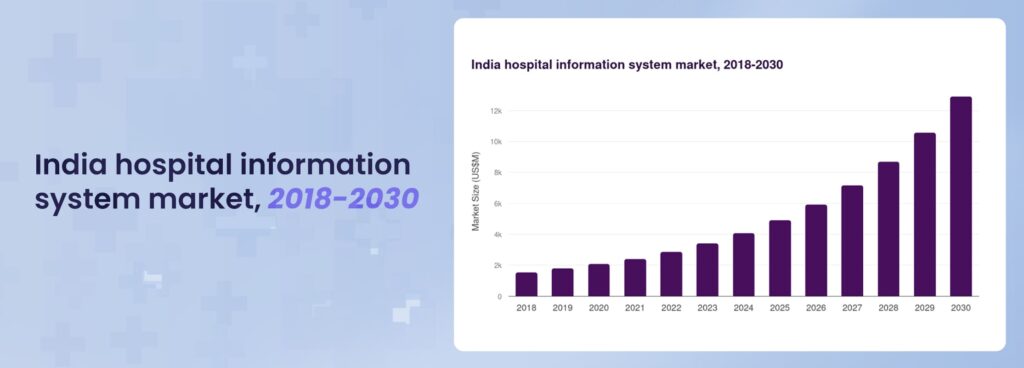
Unlike EHR/EMR (clinical records only), hospital management system software manages everything from registration to discharge, billing to bed allocation. The India hospital information system market generated USD 4.08 billion in 2024 and is expected to reach USD 12.89 billion by 2030, with a ~21.3% CAGR — showing strong growth in hospital software adoption, including clinical and operational modules. .
This complete 2026 guide explains what hospital management systems are, how they differ from EMR and EHR solutions, and the core operational areas they manage. It is designed to help hospital administrators, operations teams, and healthcare decision-makers understand the role of HMS in improving coordination, visibility, and efficiency across hospital environments.
What is Hospital Management System?
A Hospital Management System (HMS) is a comprehensive digital platform designed to integrate and streamline core hospital operations. Unlike simple Electronic Medical Records (EMR) or Electronic Health Records (EHR) systems — which focus mainly on storing patient clinical data — HMS encapsulates a much wider set of functions including administrative workflows, financial operations, and resource optimization.
At its core, HMS eliminates inefficiencies associated with fragmented data systems and manual documentation. Rather than requiring staff to re-enter patient information for each department (e.g., registration, pharmacy, lab, billing), HMS ensures that once data is captured, it flows automatically and securely across modules that need it.
Over the decades, hospital IT systems have evolved from basic administrative tools into intelligent digital platforms. Today’s hospital software systems may include real-time data processing, analytics dashboards, interoperability interfaces, and decision support tools that aid both clinical and non-clinical staff in their workflows.
How HMS Differs from EHR/EMR
| Feature | EMR / EHR | Hospital Management System (HMS) |
|---|---|---|
| Primary Focus | Clinical documentation and patient health records | End-to-end hospital operations (clinical + administrative + financial) |
| Primary Users | Doctors, nurses, and clinical staff | Entire hospital workforce (clinical, admin, finance, operations, management) |
| Scope | Patient medical history, diagnoses, medications, lab results | Patient lifecycle + billing, inventory, staff, beds, analytics, compliance |
| Core Functionality | Record creation, storage, and clinical documentation | Workflow automation across departments |
| Departments Covered | Clinical departments only | All hospital departments hospital-wide |
| Billing & Finance | Limited or external integration | Native, fully integrated billing and revenue cycle |
| Resource Management | Not included | Beds, inventory, equipment, housekeeping |
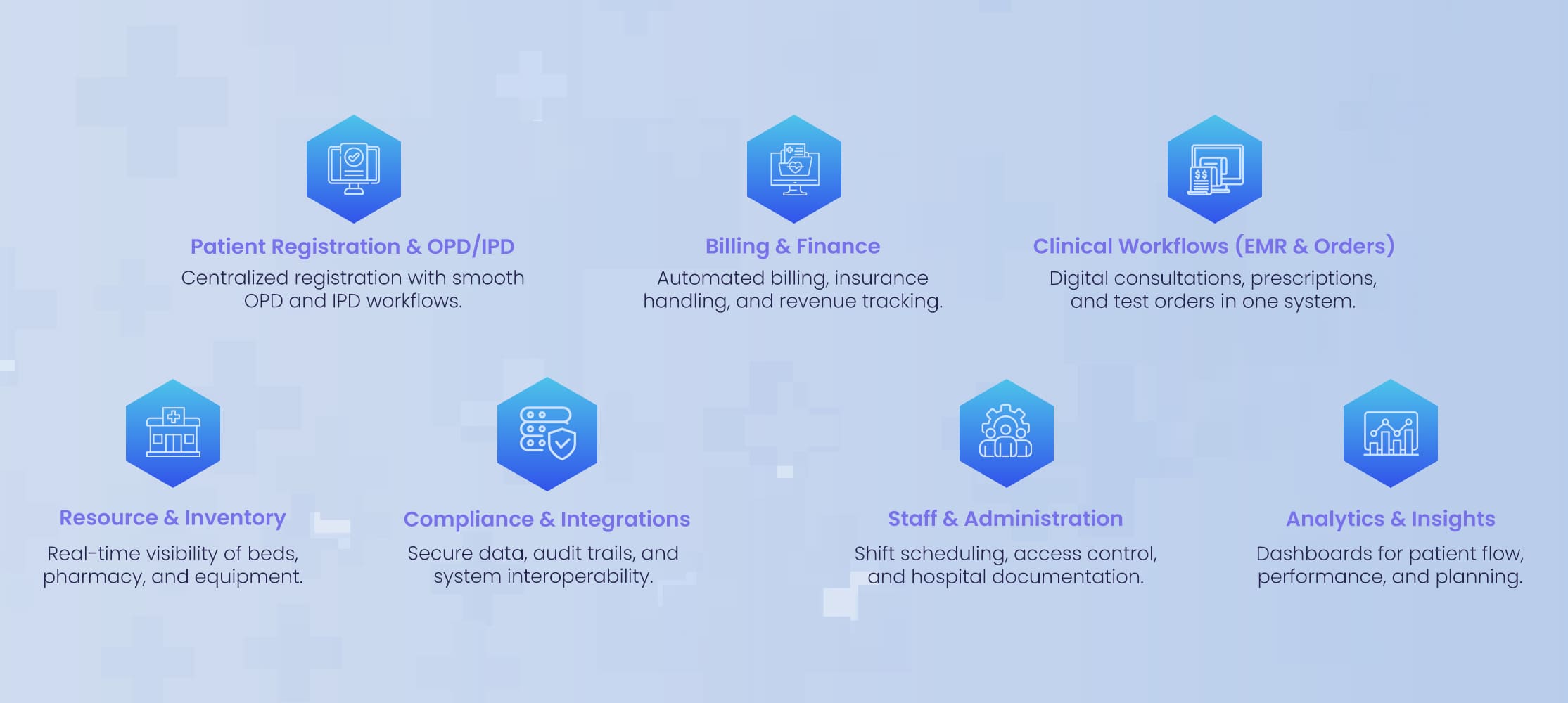
7 Core Areas Hospital Software Systems Manage
Modern hospital management software brings together clinical, administrative, and operational functions into a single, coordinated platform. Each module plays a distinct role, but their real value lies in how they work together as one Hospital Management System.
1. Patient Registration & OPD/IPD Management
Patient registration is the entry point for all hospital operations. In traditional setups, this process is often fragmented across counters, paper forms, and standalone systems. Hospital management system software replaces this with a unified digital workflow.
During registration, patient demographic details are captured once and stored centrally. The system assigns a unique patient ID(such as ABHA) that is used across OPD visits, inpatient admissions, diagnostics, pharmacy, and billing. OPD and IPD workflows are clearly distinguished, allowing hospitals to manage outpatient consultations and inpatient stays differently.
Specialty queues route patients to the appropriate departments based on appointment type or referral, while bed allocation tools track real-time availability across wards and units. This ensures smoother admissions, fewer bottlenecks, and better visibility into patient movement throughout the hospital.
2. Clinical Workflows (EMR + Orders)
Clinical workflows are the core of patient care. Hospital software systems integrate Electronic Medical Records (EMR) with ordering and documentation tools to support clinicians throughout diagnosis and treatment.
Doctors record consultations, diagnoses, and treatment plans directly into electronic patient charts. Using Computerized Physician Order Entry (CPOE), they can request laboratory tests, radiology imaging, or medications without manual forms or verbal handoffs. These orders are automatically routed to the relevant departments.
Laboratory Information Systems (LIS) and Radiology Information Systems (RIS) feed test results back into the patient record as soon as they are available. Prescriptions generated within the system are visible to the pharmacy, reducing transcription errors and ensuring continuity of care. Within a Hospital Management System, clinical data remains connected to billing, analytics, and compliance workflows.
3. Financial & Billing Operations
Financial workflows in hospitals are complex, involving multiple services, payers, and payment stages. Hospital management software centralizes billing and financial operations to improve accuracy and transparency.
As clinical and diagnostic services are delivered, charges are automatically captured and reflected in the patient’s account. The system generates itemized bills that align with services rendered, reducing disputes and omissions. Insurance-related workflows—such as eligibility checks, claims submission, and status tracking—are managed within the same platform.
Accounts receivable tracking allows finance teams to monitor outstanding payments, aging balances, and revenue trends. Cost center accounting provides visibility into departmental expenses and profitability. Together, these features help hospitals manage cash flow and maintain financial control using a single Hospital Management System.
4. Resource & Inventory Management
Hospitals depend on a wide range of physical resources that must be available at the right time and place. Hospital software systems help administrators monitor and manage these resources in a structured manner.
Bed management tools show real-time occupancy and availability across wards, ICUs, and special units, supporting admission and discharge planning. Pharmacy inventory modules track medication stock levels, expiry dates, and consumption patterns, helping reduce shortages and wastage.
Biomedical equipment tracking ensures that critical devices are available, maintained, and properly utilized. Housekeeping and facility schedules are also coordinated through the system, ensuring that rooms and wards are prepared promptly for incoming patients. Resource visibility within hospital management system software improves operational efficiency and patient readiness.
5. Staff & Administrative Operations
Hospitals operate with diverse teams working across shifts, departments, and roles. Hospital management systems support staff coordination and administrative governance through structured workflows.
Scheduling tools help allocate staff based on workload, department needs, and shift patterns. Role-based access controls ensure that users can only view or modify data relevant to their responsibilities, strengthening data security and compliance.
Administrative modules assist with generating discharge summaries, internal documentation, and reports. Incident reporting tools allow staff to record safety events or operational issues, creating an auditable trail for quality improvement. By automating routine administrative tasks, hospital management software reduces manual effort and improves accountability.
6. Analytics & Business Intelligence
Hospitals generate large volumes of operational and clinical data. Hospital management system software includes analytics and reporting tools that transform this data into meaningful insights.
Dashboards present real-time views of patient flow, bed occupancy, appointment volumes, and department performance. Key performance indicators (KPIs) help administrators identify bottlenecks, underutilized resources, or rising demand in specific services.
Historical data analysis supports forecasting and capacity planning, enabling hospitals to make informed decisions about staffing, expansion, and service optimization. Analytics within hospital software systems move decision-making from intuition-based to evidence-driven.
7. Compliance & Interoperability
Regulatory compliance and system connectivity are essential in modern healthcare environments. Hospital management software embeds compliance and interoperability into daily operations rather than treating them as separate processes.
Audit trails automatically record user activity, data changes, and access history, supporting internal reviews and external audits. Data privacy controls and encryption mechanisms help hospitals comply with regulations such as HIPAA and GDPR.
Interoperability standards like HL7 and FHIR enable secure data exchange between the Hospital Management System and external platforms, including laboratories, imaging centers, insurance systems, and telemedicine tools. Integration with connected medical devices and remote care platforms allows patient data to flow seamlessly into clinical records while maintaining security and traceability.
Bringing It All Together
Each of these modules plays a critical role, but their real strength lies in integration. When hospitals use fragmented tools, information remains siloed. A unified Hospital Management System connects people, processes, and data across the organization—creating a coordinated environment where care delivery, operations, and decision-making work in sync.
How Hospital Management Systems Actually Work
A Hospital Management System (HMS) — also referred to broadly as a Hospital Information System (HIS) — acts as a central operational platform that connects all departments and functions of a healthcare facility into a unified, data-driven workflow. Rather than siloed tools that require repeated data entry or manual handoffs, an integrated HMS ensures information flows seamlessly across care, administrative, and financial activities in real time.
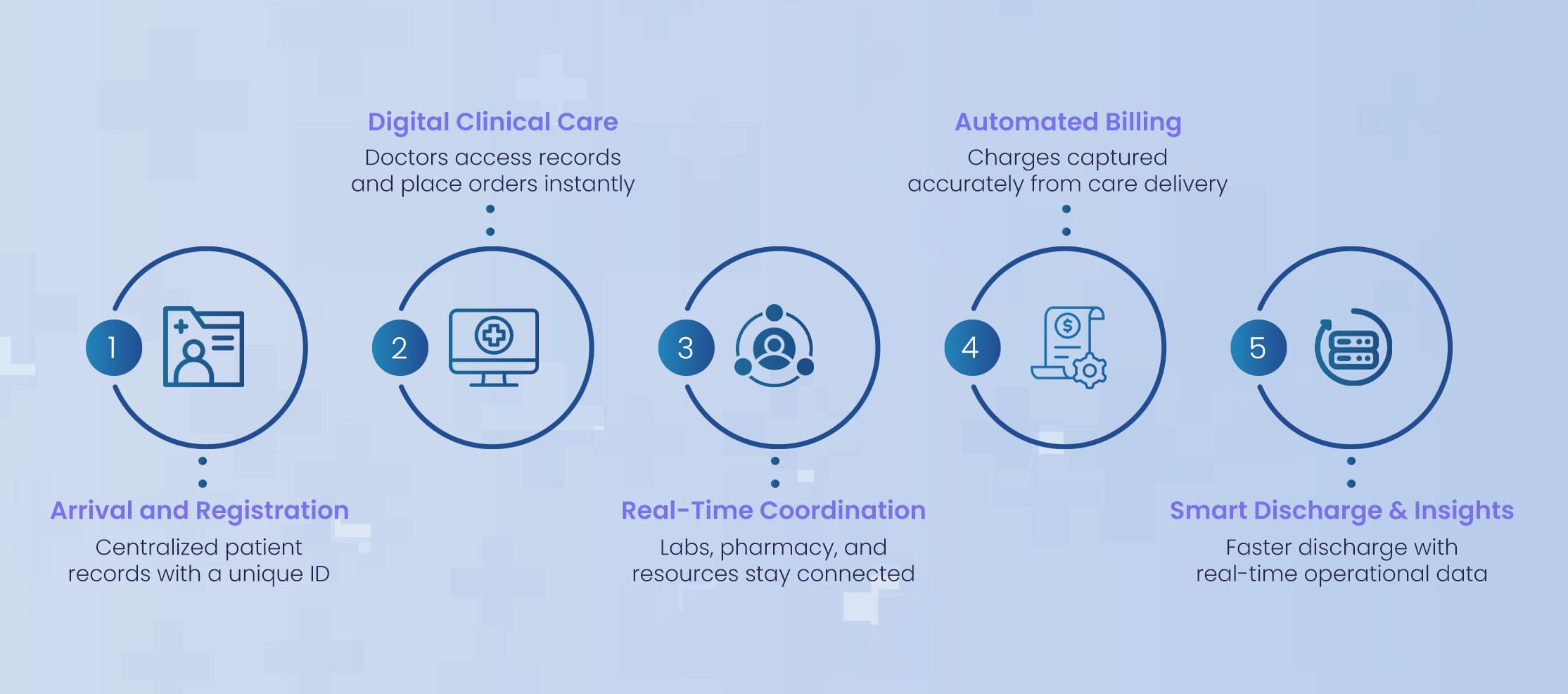
1. Arrival and Registration
When a patient arrives at a hospital, the Patient Management component captures their details once — including demographics, appointment information, insurance data, and unique identifiers — and stores it in a centralized database accessible to all authorized users.
Outcome:
Registration occurs rapidly because:
- Demographic and identification details are logged electronically
- Unique patient IDs link records across modules
- Insurance eligibility and coverage details can be verified as part of registration workflows (where connected systems support it)
2. Clinical Assessment and Orders
Once registered, clinicians can access the patient’s digital record — including prior history, tests, and ongoing conditions. Computerized Provider Order Entry (CPOE) systems allow clinicians to enter orders electronically for labs, imaging, or treatments; these orders are routed automatically to the appropriate departments without paper slips or phone calls.
Outcome
Clinical coordination improves because:
- Doctors access complete patient histories at the point of care
- Orders reach departments instantly without transcription delays
- Errors caused by illegible handwriting or verbal instructions are minimized
- Clinical workflows become more standardized across departments
- This digital coordination replaces the traditional manual handoff between providers and departments, reduces transcription errors, and improves overall workflow efficiency.
3. Lab, Pharmacy, and Resource Coordination
Once orders are placed, Lab Information Systems (LIS) and Radiology Information Systems (RIS) integrate with the HMS, enabling technicians to see pending tests and enter results directly into the shared patient record.Pharmacy modules receive prescription alerts and check stock availability. Real-time data access allows pharmacists to dispense medications and update inventory immediately without manual entry.
Outcome
Operational efficiency improves because:
- Test orders and results are tracked digitally end-to-end
- Clinicians receive results faster within the same system
- Supports faster clinical decision-making.
4. Billing and Financial Processing
Financial functions are tightly coupled with clinical and operational data in modern hospital software systems. When clinical services occur:
- Charges are captured automatically based on documented services, tests, procedures, and prescriptions.
- Billing modules generate itemized invoices, apply agreed rates or insurance contracts, and support claims submission workflows.
- Integrated eligibility and claims functions help reduce denials and speed up payment reconciliation — an important part of revenue cycle management.
Outcome
Financial accuracy improves because:
- Services rendered are instantly reflected in billing records minimizing missed charges, duplicate entries,
- Manual charge entry and reconciliation are reduced
- Billing timelines become more predictable
- Financial reporting is based on real-time operational data
5. Discharge and Performance Insights
At the end of a patient’s stay, discharge summaries, care plans, and follow-ups can be generated automatically using data already captured during the stay.
Hospital management dashboards and analytics modules provide real-time indicators of operational performance — such as occupancy rates, average lengths of stay, and resource utilization.
Outcome
Decision-making improves because:
- Discharge documentation requires less repetitive effort
- Bed availability updates faster for admissions planning
- Administrators gain visibility into operational trends
- Data supports quality improvement and compliance reporting
Top 8 Benefits of Hospital Management Systems (HMS)
Hospital Management System software delivers significant operational, clinical, and administrative advantages when implemented thoughtfully within healthcare facilities. These benefits are widely recognized in industry literature and reflected in real Indian hospital deployments and national digital health initiatives such as the Ayushman Bharat Digital Mission (ABDM) and e-Sanjeevani telemedicine platforms.
1. Faster Bed Turnover and Discharge
Hospital management systems provide real-time visibility into bed occupancy and patient status, helping staff coordinate admissions, discharges, and housekeeping more efficiently. Centralized dashboards reduce delays between discharge and reassignment, enabling better utilization of existing beds without physical expansion. By minimizing the time between when a bed becomes free and when it is reassigned, hospitals can reduce waiting times and better manage overall patient flow.
2. Reduced Medicine Stockouts
Inventory modules within hospital software systems track pharmacy stock levels digitally and trigger alerts when supplies fall below defined thresholds. This supports timely procurement, reduces dependence on manual checks, and helps avoid shortages or overstocking of critical medicines.
3. Reduced Staff Overtime
Hospital management system software automates routine administrative functions — such as appointment reminders, documentation workflows, and schedule coordination — which reduces time-consuming manual tasks. Automation leads to more predictable staffing needs and can lower the requirement for staff to work overtime to catch up on paperwork.
4. Automated Clinical Documentation and decision support
Automated clinical documentation and decision support aim to reduce the time clinicians spend on manual data entry while improving the consistency and availability of clinical information. Integrated EMR functionality helps clinicians spend less time on repetitive data entry and more time on patient care. Clinical decision support features leverage structured and real-time data — such as alerts for potential medication errors or reminders about care guidelines — to assist clinicians at the point of care.
5. Real-Time Insurance Pre-Verification and Billing Accuracy
Integrated billing and financial modules link services delivered directly to billing records. Digitized insurance workflows help reduce manual errors, support smoother claims processing, and improve financial visibility for hospitals.
6. Patient Flow Visualization
Hospital management software often includes operational dashboards and flow visualization tools that give administrators and care teams a clear view of where patients are in their journey through the facility. By making patient flows visible through charts and live status indicators, hospital staff can adjust resources and staff allocation more quickly, avoid crowded waiting areas, and manage queues more effectively.
7. Automated Compliance Reporting
Hospital management software (HMS) simplifies regulatory compliance by capturing clinical and administrative data digitally and consistently. Features such as timestamped audit trails, role-based access, and structured documentation, demonstrate accountability and transparency during inspections or audits. This is especially relevant for meeting NABH accreditation requirements, which emphasize accurate records and traceable processes.
8. Telemedicine Integration and Virtual Care Management
Many modern HMS platforms integrate telemedicine workflows, allowing hospitals to manage virtual consultations, appointments, and records within the same system. This helps extend care access and reduces dependency on physical visits where appropriate.
India’s national telemedicine platform eSanjeevani has delivered millions of consultations, demonstrating how remote care can reduce foot traffic in physical waiting areas and expand access to health services.
2026 HMS Trends & Technologies
1. Artificial Intelligence & Machine Learning
Artificial Intelligence (AI) and Machine Learning (ML) help hospital and clinic software work smarter using everyday data. AI studies past clinic data — appointments, patient visits, billing patterns, and treatments — to predict trends, highlight risks, and reduce manual work. This allows clinics to run more smoothly while maintaining consistent quality of care.
How AI helps in real clinic operations
- Predictive insights for better planning
AI can identify busy hours, predict patient no-shows, and flag patients who may miss follow-ups. This helps clinics manage appointment slots, staffing, and resources more efficiently. - Clinical decision support
AI assists doctors by organizing patient history, highlighting relevant information, and providing reminders based on standard treatment guidelines — supporting decisions without interfering with clinical judgment. - Voice AI for faster documentation
Voice-enabled AI allows doctors to speak naturally during or after consultations while the system converts speech into structured clinical notes. This significantly reduces typing, shortens consultation time, and helps maintain accurate records without breaking doctor–patient interaction. - Smarter documentation and administration
AI helps create discharge summaries, visit notes, and administrative reports faster and with fewer errors, ensuring consistency across departments.
2. Interoperability Standards (HL7 & FHIR)
HL7 and FHIR are common “languages” that different healthcare systems use to talk to each other. When a hospital management system follows these standards, patient data can move between systems without re-entering information or creating errors.
What does this mean in everyday clinic operations
- No repeated data entry
Patient details entered once can flow automatically to labs, pharmacies, referral hospitals, insurance systems, and diagnostic centers. - Faster reports and referrals
Lab results, imaging reports, and discharge summaries can be shared instantly with doctors or other healthcare providers, reducing delays in treatment. - Easier integration with government and insurance systems
Interoperability makes it easier to connect with national digital health programs, insurance platforms, and third-party services without custom development. - Better continuity of care
When patients move between clinics, hospitals, or specialists, their medical history can travel with them — reducing duplication of tests and improving decision-making.
3. Telemedicine Integration
Instead of running virtual consultations on standalone apps, modern HMS platforms integrate telemedicine directly into daily clinic workflows. This means online consultations, in-person visits, prescriptions, payments, and follow-ups all happen within one connected system.
Operational benefits for clinics and hospitals
- Reduced waiting room congestion
A portion of OPD traffic shifts online, improving patient flow inside the facility. - Better doctor time utilization
Doctors can handle more follow-ups and routine consultations in less time. - Expanded reach beyond location
Clinics can serve patients from nearby towns or rural areas without opening new branches. - Stronger care continuity
Follow-ups, chronic disease monitoring, and post-discharge check-ins become easier and more consistent.
4. Internet of Medical Things (IoMT)
IoMT refers to medical devices and equipment that connect to digital systems and automatically send health information securely over networks. This includes everything from wearable health monitors to in-clinic diagnostic devices and connected hospital equipment.
Practical Clinic Benefits of IoMT
- Real-time patient monitoring
Devices continuously collect and transmit vital signs, helping clinicians spot changes in health sooner and take proactive action rather than waiting for the next scheduled check-in. - Stronger data continuity
IoMT ensures that patient health metrics are stored directly in the hospital or clinic system, reducing manual data entry and improving accuracy. - Support for remote care
Connected devices make telemedicine and remote consultations more effective because clinical data (such as vitals or glucose levels) can be reviewed during or before virtual visits. - Operational efficiency
Tracking equipment location, use, and status helps staff find and utilise resources like monitors or infusion pumps efficiently, reducing delays and idle time
5. Voice-Activated Interfaces and Ambient AI
Instead of doctors and nurses typing or clicking through screens, modern systems allow them to use their voice to create and update medical records, place orders, and interact with the hospital management system software.
This trend stems from advancements in voice recognition and natural language processing (NLP) — the same kinds of technologies that allow smartphones and virtual assistants to understand spoken language but trained specifically for medical contexts. These systems learn medical terminology and patterns from healthcare speech, which helps them convert spoken words into structured clinical documentation accurately and quickly.
Benefits for Clinics and Hospitals
Voice-activated interfaces in a Hospital Management System can deliver several practical benefits:
- Reduced documentation burden
Clinicians spend less time typing notes, freeing up time for patient interaction and care planning. This aligns with findings that voice recognition can cut documentation time significantly compared with manual note entry. - Improved data accuracy
Trained voice recognition systems tend to reduce mistakes from manual typing or handwritten notes, leading to more complete and reliable clinical records. - Greater clinician satisfaction
With less administrative work, clinicians report lower stress and more time with patients, which contributes to job satisfaction and helps address burnout — a major issue in healthcare. - Faster work-flows
Instead of typing or transcribing later, voice-activated documentation happens in real time or near real time, improving the speed of clinical documentation and operational processes.
6. Cloud & Mobile Accessibility
Cloud technology allows hospital management software to run on secure online servers instead of being installed and maintained entirely within the hospital. This means hospitals no longer need to depend on expensive hardware, constant IT maintenance, or manual software updates.
With a cloud-based Hospital Management System, patient records, billing data, schedules, and reports are stored centrally and accessed securely through the internet. Doctors, nurses, and administrators can log in from authorized devices—whether they are inside the hospital, at another branch, or working remotely.
Mobile access further improves flexibility. Clinicians can review patient charts, lab results, and discharge notes on tablets or smartphones, while administrators can monitor operations and alerts without being physically present at a desk.
Why this matters for hospitals and clinics
- Faster access to patient information across departments and locations
- Easier system upgrades without service disruption
- Better support for multi-branch hospitals and clinics
- Reduced IT infrastructure and maintenance costs
- Cloud and mobile accessibility make hospital software systems more resilient, scalable, and practical for everyday operations.
Conclusion
Hospital management software has evolved into a core operational system for modern healthcare facilities, supporting everything from patient registration and clinical workflows to billing, compliance, and analytics. As hospitals and clinics grow in complexity, managing these functions through disconnected tools or manual processes becomes increasingly inefficient and error-prone.
A well-implemented Hospital Management System brings structure, visibility, and coordination across departments. By centralizing data and automating routine workflows, hospital software systems help healthcare providers improve operational efficiency, reduce administrative burden, and make more informed decisions—without compromising clinical care.
As healthcare delivery continues to shift toward digital-first models, HMS platforms are no longer optional add-ons but foundational infrastructure. For hospitals evaluating digitization or planning system upgrades, understanding how hospital management system software works, the benefits it delivers, and the technologies shaping its future is a critical first step toward sustainable, scalable operations.


Leave a reply