



Ultimate Guide to Cloud Computing in Healthcare (2025): Models, Benefits & Challenges

Anagha Venugopal

What is Cloud Computing in healthcare?
Cloud computing refers to the delivery of on-demand IT resources—such as servers, storage, databases, and software—over the internet. Instead of investing in and maintaining physical hardware, healthcare organizations can “rent” scalable infrastructure from providers like AWS, Microsoft Azure, or Google Cloud.
In the context of cloud-based healthcare, this model enables faster innovation, cost savings, and improved accessibility to critical applications. A robust healthcare cloud platform supports everything from electronic health records (EHRs) and telemedicine to data analytics and patient engagement tools, making it a key enabler of modern, efficient, and patient-centered care.
Types of Cloud Deployment Models in Healthcare
Cloud computing in healthcare offers flexible deployment options tailored to meet the specific needs of medical institutions, from data sensitivity to scalability and compliance. Here are the three primary deployment models:
- Public Cloud: In this model, services are delivered by third-party providers like AWS, Google Cloud Platform, or Microsoft Azure and are shared among multiple organizations. It’s a cost-effective option for healthcare providers to run less sensitive applications and manage non-critical data.
- Private Cloud: A private cloud is dedicated to a single healthcare organization. It can be hosted on-premises or by a third-party vendor. This model provides greater control, security, and compliance, making it ideal for storing sensitive patient data and running mission-critical healthcare applications.
- Hybrid Cloud: A blend of public and private cloud environments, the hybrid approach allows healthcare organizations to optimize both performance and security. Sensitive health records can be secured in a private cloud, while public cloud resources can handle scalable workloads like analytics, patient portals, or telehealth services.
By adopting the right deployment model, healthcare providers can fully harness the potential of cloud computing in healthcare—balancing cost, security, and performance to improve patient outcomes and operational efficiency.
Types of Cloud computing Solution in Healthcare
Cloud computing in healthcare enables organizations to access IT resources on-demand without managing physical infrastructure. The three primary service models—SaaS, IaaS, and PaaS—offer different levels of control and flexibility. Here’s how each model supports cloud-based healthcare delivery:
1. Software as a Service (SaaS)
SaaS delivers ready-to-use healthcare applications over the internet, hosted and managed by third-party providers. Users simply log in via a web browser or app—no installations or infrastructure maintenance required.
Use Case in Healthcare:
- Cloud-based Electronic Health Record (EHR) systems
- Telemedicine and virtual care platforms
- Medical billing and patient engagement solutions
Benefits for Cloud-Based Healthcare:
- Faster implementation with minimal setup
- Automatic updates and security patches
- Accessible from any location or device
- Reduces IT burden for healthcare providers
2. Infrastructure as a Service (IaaS)
IaaS provides virtualized computing resources like storage, servers, and networking components on a pay-as-you-go basis. Ideal for organizations needing a scalable, secure foundation for custom deployments.
Use Case in Healthcare:
- Hosting legacy healthcare systems in the cloud
- Storing large volumes of medical imaging data
- Supporting high-performance computing for genomics and research
Benefits for Cloud Computing in Healthcare:
- Scalable storage and computing power on demand
- High availability and disaster recovery
- Reduces capital expenses on hardware
- Supports rapid experimentation and innovation
3. Platform as a Service (PaaS)
PaaS offers a cloud-based environment with tools and frameworks for developers to build, test, and deploy healthcare applications without managing underlying infrastructure.
Use Case in Healthcare:
- Developing custom health analytics dashboards
- Building interoperable health information exchange (HIE) systems
- Integrating AI-powered diagnostic tools
Benefits for Healthcare Cloud Platforms:
- Speeds up development cycles
- Encourages innovation in care delivery
- Ensures compliance with healthcare data regulations
- Provides seamless integration with other cloud services
Why Healthcare has been slow to adopt Cloud-Based Solutions?
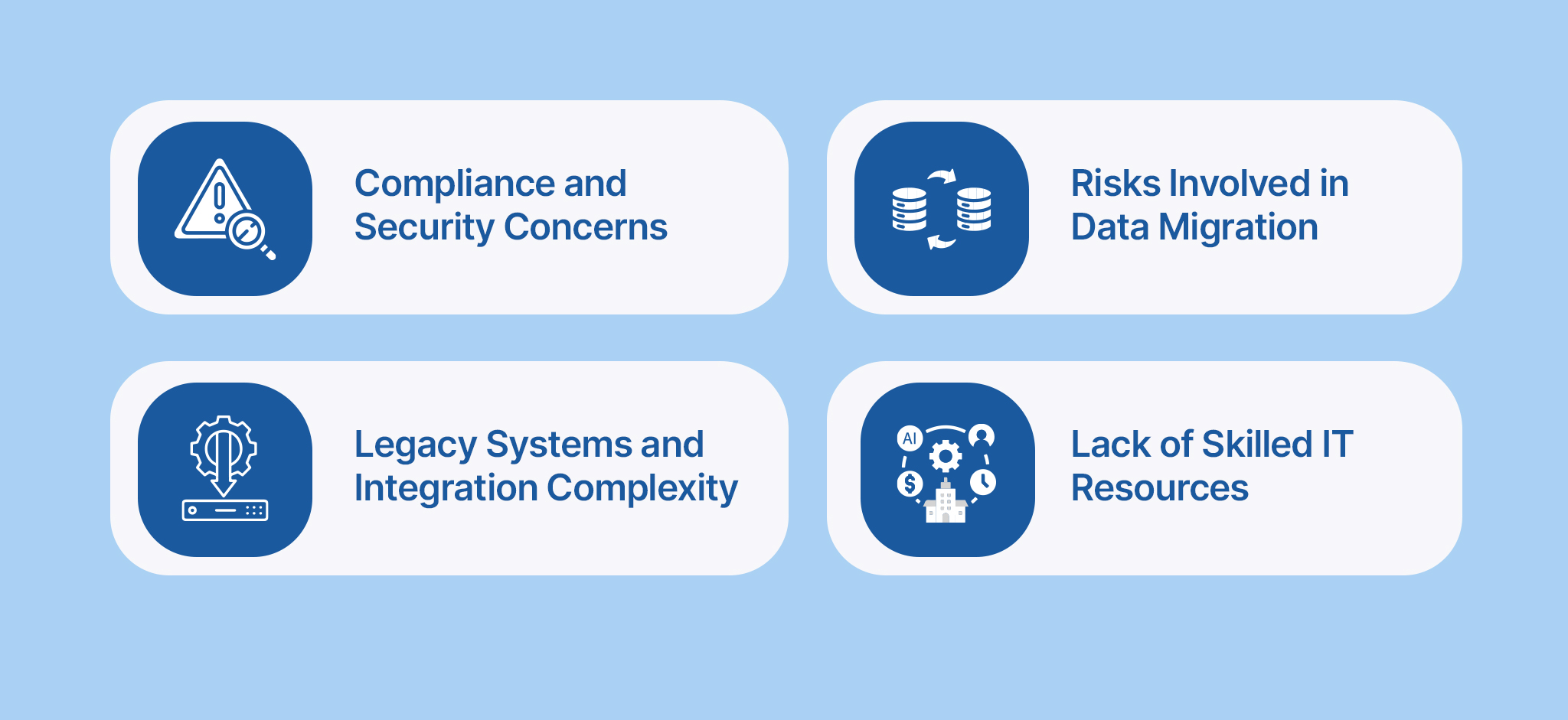
While cloud-based healthcare platforms and hospital management systems have gained momentum—especially in the post-COVID era—adoption across the healthcare industry still lags behind other sectors. According to recent insights, nearly 47% of healthcare organizations still operate exclusively on traditional, non-cloud data centers. The shift to a healthcare cloud platform faces several key challenges:
1. Compliance and Security Concerns
Handling sensitive patient data comes with heavy regulatory obligations like HIPAA, GDPR, and local data protection laws. Concerns around how healthcare data is stored, who owns it, and how it’s secured in the cloud create resistance toward cloud adoption. Healthcare providers are generally cautious about entrusting critical data to third-party cloud platforms.
2. Risks Involved in Data Migration
Migrating massive volumes of patient records, medical histories, and operational data to a cloud-based healthcare system is not only resource-intensive but also carries the risk of data corruption, loss, or downtime. These disruptions can affect patient care, reduce trust, and jeopardize operational efficiency.
3. Legacy Systems and Integration Complexity
Many hospitals and clinics still rely on legacy systems that were never designed for cloud compatibility. Integrating these outdated systems into a modern healthcare cloud platform requires significant investment, time, and custom development, deterring many providers from making the switch.
4. Lack of Skilled IT Resources
Successful cloud migration requires specialized skills in cloud architecture, cybersecurity, and healthcare IT compliance. Unfortunately, many healthcare organizations lack in-house expertise to implement and manage cloud-based healthcare solutions effectively. This skills gap often results in delayed or abandoned cloud initiatives.
Why Cloud Computing is now essential for Modern Healthcare?
While concerns around security and legacy system integration are valid, the growing complexity and demands of modern healthcare make it clear: cloud computing in healthcare is not just beneficial—it’s essential. Continuing to rely on traditional IT infrastructure poses serious risks to operational efficiency, care quality, and long-term scalability.
The Hidden Costs of Legacy Healthcare Systems
Outdated, on-premise systems present numerous obstacles that cloud computing can solve:
- High Operational Costs: Traditional infrastructure requires significant upfront investment in hardware, licenses, and IT teams. Ongoing maintenance, upgrades, and security costs drain healthcare budgets, while scaling remains inefficient and costly.
- Physical Space Limitations: On-site servers consume valuable hospital or clinic space—space that could be better used for patient services or medical equipment.
- Disaster Vulnerability: With no cloud backup, local data is highly susceptible to fire, flood, or hardware failure. On-premise disaster recovery systems are often expensive and complex to implement.
- Limited Scalability and Agility: Traditional IT systems lack the flexibility to rapidly scale based on demand. In contrast, cloud computing in healthcare offers instant scalability to manage peak loads or expand services as needed.
How Cloud Computing Connects Healthcare Data
One of the most critical drawbacks of legacy systems is the creation of data silos—isolated pockets of patient data across departments or locations. Cloud computing resolves this challenge by enabling seamless data sharing through centralized platforms.
- Improved Collaboration: Top-tier institutions like the Mayo Clinic rely on multidisciplinary teams to make accurate diagnoses. Cloud-based healthcare systems provide real-time access to unified patient records, enabling collaboration across departments and improving care coordination.
- Reduced Costs and Redundancy: Data silos often result in repeated diagnostic tests and redundant procedures. Healthcare cloud platforms reduce these inefficiencies by giving doctors access to shared patient data, saving time and reducing patient expenses.
- Faster Diagnosis and Treatment: In traditional systems, fragmented data leads to delays and errors in treatment. Cloud computing in healthcare ensures providers access comprehensive medical histories and test results instantly—minimizing diagnostic delays and enhancing patient safety.
By addressing the limitations of legacy systems and dismantling data silos, cloud computing in healthcare lays the foundation for a smarter, more efficient, and patient-centric ecosystem.
COVID-19: A Wake-Up Call for Cloud-Based Healthcare
The COVID-19 pandemic brought unprecedented challenges to healthcare—most notably, the urgent need to provide care remotely without exposing patients or staff to the virus. This sudden shift made cloud-based healthcare solutions essential, exposing the limitations of traditional healthcare IT infrastructure in supporting remote care delivery.
With healthcare staff working remotely and patients requiring virtual consultations, maintaining on-site systems became increasingly difficult. The pandemic also triggered a surge in cyberattacks, underscoring the urgent need for stronger, specialized security. Today, many healthcare organizations recognize that partnering with certified healthcare cloud solution providers offers superior cybersecurity and compliance—far beyond what in-house teams can typically achieve.
Why Healthcare Needs Digital Transformation?

In the fast-evolving healthcare landscape, digital transformation is no longer optional—it’s a critical necessity. Healthcare providers clinging to outdated systems risk falling behind in quality, efficiency, and competitiveness.
Recognizing this, the World Health Organization (WHO) launched the Global Observatory for eHealth (GOe) to track how digital innovations improve healthcare worldwide. The WHO highlights that remote healthcare, bridges geographical divides through real-time video consultations between patients and providers. These digital interactions enable:
- Accurate diagnoses
- Personalized treatment plans
- Effective disease prevention
- Collaborative research to enhance public health
Embracing a robust healthcare cloud solution is fundamental to this transformation. It helps overcome the limitations of legacy IT, breaks down data silos, enhances collaboration, and ultimately, enables healthcare organizations to deliver safer, more efficient, and patient-centered care.
Different key features of Cloud computing in Healthcare
After exploring why healthcare organizations must boldly transition to cloud computing in healthcare, let’s dive deeper into the key benefits of adopting cloud technology in the healthcare sector.
1. Reduce Costs with Cloud Computing in Healthcare
- Lower Upfront Investment: Leveraging cloud computing in healthcare eliminates the need for costly hardware, IT infrastructure, and software licenses, drastically lowering initial expenses for providers.
- Reduced Maintenance Costs: Cloud service providers manage maintenance, updates, and security, freeing internal IT teams and significantly reducing operational costs for healthcare organizations.
2. Enhance Scalability and Flexibility
- Effortless Scaling: Cloud computing in healthcare enables dynamic adjustment of computing power and storage based on demand—scaling up during peak times or down during quieter periods—optimizing costs and resources.
- Rapid Deployment: Cloud platforms allow healthcare providers to quickly deploy new applications and services without hardware procurement delays, supporting agile responses to evolving patient needs.
3. Foster Collaborative Care through Cloud Solutions
- Seamless Data Sharing: Cloud-based healthcare platforms enable secure, efficient data sharing within and across organizations, improving care continuity.
- Real-Time Collaboration: Cloud computing in healthcare facilitates virtual consultations, specialist referrals, and joint treatment planning, bridging geographic gaps and enhancing access to specialized care.
- Improved Communication: Cloud collaboration tools streamline workflows, promoting better coordination among healthcare teams.
4. Expand Remote Care and Telemedicine via Cloud
- Increased Access: Cloud infrastructure empowers telemedicine and remote patient monitoring programs, extending care beyond traditional clinical settings.
- Convenient Care: Patients benefit from receiving care at home, improving comfort, adherence, and outcomes through cloud-enabled healthcare services.
5. Eliminate Data Silos and Standardize Data with Cloud Computing
- Centralized Data Storage: Cloud computing in healthcare consolidates patient information into a single repository, breaking down data silos for a comprehensive patient view.
- Data Standardization: Ensures consistent, high-quality data across healthcare systems, enabling reliable analysis and better clinical decision-making.
- Improved Accessibility: Authorized personnel securely access critical data anytime, anywhere, supporting timely and informed care.
6. Strengthen Backup and Disaster Recovery
- Robust Data Protection: Cloud-based backup and disaster recovery solutions safeguard sensitive healthcare data against loss from unforeseen events.
- Business Continuity: Enables rapid restoration of systems and data, minimizing disruption to patient care during emergencies.
7. Embrace Sustainability with Cloud Computing in Healthcare
- Reduced Energy Consumption: Unlike traditional on-premise data centers that consume substantial amounts of energy, cloud, being a distributed network of servers, utilises power more efficiently, allowing, healthcare organizations to dramatically reduce their energy consumption, with some studies indicating potential savings of up to 80%.
- Eco-Friendly Infrastructure: Cloud providers like AWS are committed to sustainability and invest heavily in energy-efficient data center designs through innovative technologies and practices to optimize energy and water use. For example, AWS’s global PUE(Power Usage effectivemess) in 2023 was 1.15, significantly lower than the estimated PUE of 1.84 for on-premise data centers.
By embracing cloud computing in healthcare, organizations can transform operational efficiency, enhance patient care, and contribute to a sustainable future, all while staying competitive in a rapidly evolving digital healthcare landscape.
Busting Common Myths About Cloud Security

Security remains one of the biggest concerns when adopting a healthcare cloud solution, often fueled by myths and misunderstandings. But the reality is that many of these concerns are outdated or based on misconceptions. Let’s break them down:
Myth 1: “Cloud is less secure”
Reality: Leading cloud providers like Amazon AWS, Microsoft Azure, and Google Cloud Platform invest heavily in security—often far more than most on-premise setups can afford. These providers maintain top-tier data centers, employ dedicated cybersecurity teams, and ensure constant infrastructure updates to counter emerging threats.
The issue isn’t with the cloud based healthcare infrastructure itself—but with how it’s used. According to Gartner, by 2025, 99% of cloud security failures will be the customer’s fault, not the cloud provider’s. This highlights the need for proper internal governance, access control, and user awareness within healthcare organizations.
Myth 2: “The Cloud Provider is solely responsible for data security”
Reality: In any cloud based healthcare setup, security follows a shared responsibility model:
- Provider’s Role: The cloud service provider (CSP) secures the cloud infrastructure—physical security (data centers, environmental controls), network protection (firewalls, intrusion detection), and system integrity.
- Client’s (Healthcare Organization) Role: The healthcare entity must secure data stored and processed in the cloud. This includes user access controls, authentication protocols, data encryption, key management, and securing any applications and operating systems deployed.
How responsibilities are shared depends on the cloud service model:
- In IaaS (Infrastructure as a Service), the healthcare organization is responsible for operating systems and apps.
- In SaaS (Software as a Service), more responsibility lies with the provider.
Think of it this way: the cloud provider secures the foundation; the healthcare organization secures the house built on it.
Myth 3: “We’ll lose control of our data”
Reality: Adopting a healthcare cloud solution doesn’t mean surrendering control over data. It means handing over the infrastructure management (hardware, software upgrades) while retaining full authority over the data itself.
Cloud providers offer admin-level access, detailed audit logs, and robust privacy measures. This shift not only saves time and operational costs but also enhances focus on core healthcare delivery.
Bottom Line
Cloud security isn’t about blind trust. It’s about:
- Understanding the shared responsibility model
- Choosing certified and audited cloud providers
- Implementing strong internal controls and compliance policies
- Continuously monitoring performance and access
When executed properly, a cloud based healthcare environment can actually strengthen data security, improve compliance, and ensure better protection of sensitive health records.
How to Start Your Cloud computing Journey in Healthcare?

Cloud computing in healthcare is transforming the way medical organizations store, manage, and access data. But making the transition requires a clear strategy. Here’s a step-by-step guide to help healthcare organizations begin their cloud adoption journey the right way:
Step 1: Assess Your Current IT Infrastructure
Before diving into cloud computing in healthcare, evaluate your existing IT landscape. Identify:
- Which applications are cloud-ready
- Which ones need modification or modernization
- Outdated systems that should be retired or replaced
Also, consider which applications must remain on-premise due to regulatory or operational needs, and plan for how these systems will integrate with your future cloud-based healthcare environment. Be sure to define your security, compliance, and performance requirements early on.
Step 2: Choose the Right Cloud Partner
Selecting the right provider is critical to a successful healthcare cloud migration. Look for a vendor with:
- Experience in cloud computing in healthcare
- Strong security and compliance certifications (like HIPAA, HITECH, or ISO/IEC 27001)
- Scalable services that match your organization’s needs
Decide between public, private, or hybrid cloud models, and pick a service model (IaaS, PaaS, or SaaS) that aligns with your technical capabilities and workload demands.
Step 3: Plan Your Cloud Migration
Treat migration as a roadmap-driven project. A well-defined plan should include:
- A phased timeline with key milestones
- Migration steps and task ownership
- Budget considerations and cost-control strategies
- A post-migration testing and validation process
A clear migration strategy reduces downtime, minimizes risks, and ensures a smooth transition to cloud computing in healthcare.
Step 4: Rigorous Testing and Validation
Before going live, validate the cloud environment by testing its:
- Performance and uptime
- Data security and compliance with healthcare regulations
- Integration with on-premise systems
This is crucial for ensuring your cloud-based healthcare systems function reliably and meet legal and clinical requirements.
Step 5: Train and Support Your Team
A successful shift to cloud computing in healthcare also depends on your people. Provide:
- Hands-on training for staff on new tools and processes
- Education on compliance protocols and data security best practices
- Continuous support as they adjust to the new system
Empowering your team with the right knowledge ensures better adoption and fewer operational hiccups.
Transitioning to cloud computing in healthcare is more than a tech upgrade—it’s a strategic move toward better scalability, efficiency, and patient care. By following these steps, healthcare organizations can unlock the full potential of cloud while staying secure, compliant, and future-ready.
The Future of Cloud computing in Healthcare

Cloud computing in healthcare is not just transforming the present state of healthcare; it’s shaping the future of the industry. With initiatives like Saudi Arabia’s Vision 2030 and Health Sector Transformation Program, governments and organizations are embracing cloud-based innovations at scale.
A prime example is the implementation of VMware Cloud Foundation by Saudi Arabia, a hybrid healthcare cloud solution in line with its ‘Vision 2030 and Health Sector Transformation Program’. This multi-cloud strategy has helped the Ministry of Health in Saudi Arabia modernizing its IT infrastructure across a vast network of healthcare facilities, bolstering operational efficiency within the healthcare sector.
Trend 1: AI and Predictive Analytics
One of the most impactful advancements supported by cloud computing in healthcare is the integration of AI and machine learning (ML). These technologies allow healthcare providers to analyze large volumes of patient data to identify trends, predict disease outbreaks, and personalize treatments.
For example, BlueDot—a Canadian AI company—issued one of the first warnings about the COVID-19 outbreak using predictive analytics. Cloud platforms like AWS provide scalable infrastructure and services like Amazon SageMaker, which enable healthcare organizations to build, train, and deploy machine learning models on massive datasets, making healthcare cloud solutions even more intelligent and proactive.
Trend 2: Interoperability via FHIR
Data interoperability remains a major barrier in healthcare due to varying systems and data models. Healthcare cloud solutions are helping break down these silos.
The Fast Healthcare Interoperability Resources (FHIR) standard—supported by cloud platforms like Google Cloud—offers APIs that unify healthcare data into a common format. By enabling seamless data exchange between providers, payers, patients, and researchers, FHIR helps achieve better care coordination, reduces administrative friction, and facilitates large-scale healthcare research.
Trend 3: Edge Computing in Healthcare
Edge computing, a growing extension of cloud computing in healthcare, brings computation closer to where data is generated—be it in wearables, diagnostic machines, or remote clinics.
In healthcare, edge computing allows for real-time processing of data from devices like ECG monitors or glucose trackers, right at the source. This significantly reduces latency and ensures that critical data can inform decisions immediately, especially in emergency scenarios or rural areas. When integrated with cloud platforms, edge computing creates a hybrid model—balancing real-time insights with centralized data management.
Looking Ahead
The future of cloud computing in healthcare will be driven by smarter technologies, enhanced data interoperability, and decentralized processing capabilities. From healthcare cloud solutions that support AI-driven diagnostics to real-time patient monitoring through edge computing, the cloud is becoming the backbone of a more agile and innovative healthcare ecosystem.
Wrapping Up
Cloud computing in healthcare is no longer a futuristic concept—it’s a present-day necessity. The question isn’t ‘if’ healthcare organizations should adopt the cloud, but ‘how’ to do it effectively. While concerns around security, legacy systems, and data migration are understandable, the benefits of cloud adoption far outweigh these challenges.
More than just a technological upgrade, cloud computing in healthcare addresses some of the most persistent pain points in the industry—from fragmented data systems to limited scalability. It empowers healthcare providers to break free from outdated infrastructure, unify siloed information, and deliver truly innovative, patient-centered care.
As the healthcare industry stands at the intersection of tradition and transformation, the cloud offers a powerful path forward. By embracing cloud computing in healthcare, organizations can improve outcomes, streamline operations, reduce costs, and—most importantly—put patients at the center of care delivery.
Frequently Asked Questions(FAQs)
1. What is Cloud Computing in Healthcare?
Cloud computing in healthcare refers to the use of remote servers hosted on the internet to store, manage, and process medical data and applications—rather than relying on local servers or personal computers. This allows healthcare providers to securely access patient information, clinical tools, and other systems from anywhere, improving collaboration and care delivery.
2. What are the Biggest Security Concerns of a healthcare cloud solution?
Security is one of the top concerns when it comes to cloud-based healthcare. The key challenges include:
- HIPAA compliance and other data protection regulations
- Risk of unauthorized access to sensitive medical records
- Data breaches or accidental leaks
- Ensuring end-to-end encryption and secure access protocols
Leading cloud providers address these with robust security frameworks, including role-based access control, continuous monitoring, regular audits, and advanced encryption standards to keep patient data safe.
3. How Does Cloud Computing Reduce Costs?
Cloud computing helps healthcare organizations cut costs in multiple ways:
- No need for expensive on-site servers or infrastructure
- Reduced IT staff and maintenance expenses
- Pay-as-you-go pricing—you only pay for what you use
- Scalability, allowing you to adjust resources based on real-time demand
This model offers flexibility, operational efficiency, and significant cost savings, especially for small to mid-sized clinics.
4. Advantages of a cloud computing in healthcare?
- Reduce costs with cloud computing in healthcare by avoiding heavy upfront investments in hardware and only paying for the resources actually used.
- Enhance scalability and flexibility as cloud systems can easily grow or shrink based on the clinic’s changing needs.
- Foster collaborative care through cloud solutions by giving multiple healthcare professionals secure access to patient data from different locations.
- Expand remote care and telemedicine via the cloud by enabling virtual consultations and remote monitoring for patients in distant or underserved areas.
- Eliminate data silos and standardize data with cloud computing by bringing information from various departments into a single, organized system.
- Strengthen backup and disaster recovery through automatic data backups and secure storage that ensures quick recovery during any disruption.
- Embrace sustainability with cloud computing in healthcare by reducing the need for on-site servers and lowering energy consumption.
5. Which Cloud Platform is Best for Healthcare?
Amazon Web Services (AWS) is a top choice for healthcare organizations. With its specialized offering—AWS for Health—it provides secure, compliant, and scalable solutions tailored for healthcare and life sciences.
Dochours, a cloud-based clinic management software, leverages AWS to ensure secure and reliable data storage. By combining the power of cloud computing in healthcare with AWS’s infrastructure, Dochours offers clinics a modern, efficient, and compliant way to manage appointments, patient records, billing, and more.

